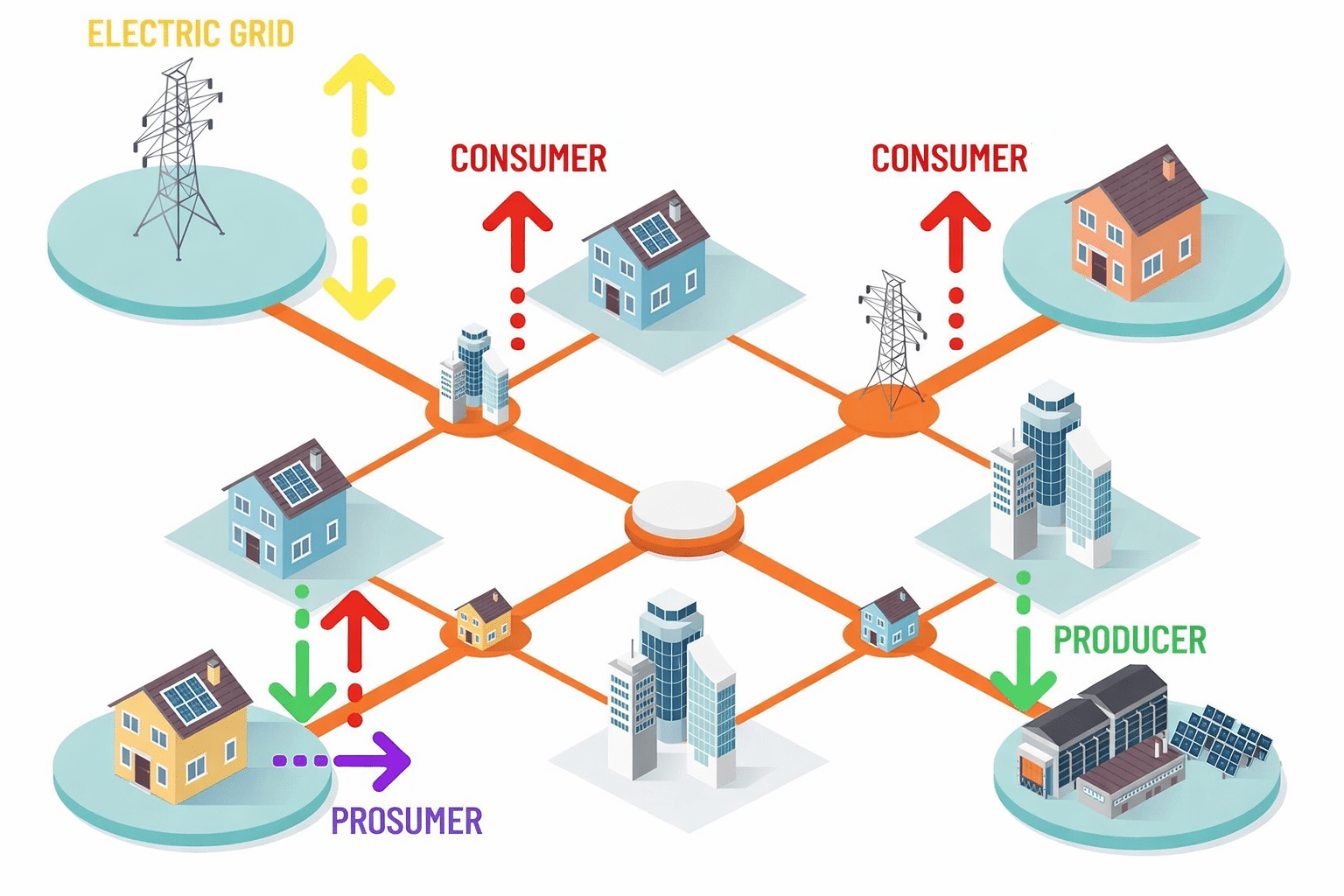
What is an Energy Community?
An energy community is a legal entity based on open and voluntary participation, whose main goal is not financial profit but the creation of environmental, economic, and social benefits for its members and the territory where it operates.
To preserve the non-profit nature of energy communities, companies operating in the energy sector (suppliers or ESCOs) cannot participate as members, although they may provide services and infrastructure.
The advantage of shared energy What is the incentive, and how is it calculated?
Shared energy is not physically identifiable.
It is a value calculated through an algorithm based on hourly measurements. By installing meters on each user that produces or consumes energy within the community, it is possible to determine every hour how much renewable energy is produced and how much is consumed by community members.
Shared energy corresponds, for each hour, to the lower value between the energy produced and the energy consumed.
The incentive tariff applied to shared electricity depends on the size of the system and the price of energy.
To maximize the value generated by an energy community, systems must be properly sized and consumption carefully monitored.